From Intent to Action: Agentic AI for Vehicle Dynamics in Modelon Impact


Artificial intelligence is already capable of turning engineering intent into executable models. The next step is putting that capability to work. Previously, we explored why equation-based, physics-driven modeling is uniquely suited for AI. Now, we move from capability to application. What happens when AI is not just generating models, but actively participating in engineering workflows? In this post, we show how that same foundation enables a new kind of interaction, where engineers move from intent to action through structured, AI-assisted execution inside Modelon Impact.
A Different Kind of Engineering Conversation
Vehicle dynamics engineering is iterative by nature. I form a hypothesis, design a study, run it, interpret the results, and decide what to do next. Each step requires judgment. Most of the time, the judgment is not the hard part, the execution is. What changes with an AI agent is not the judgment. That stays with me. What changes is that execution becomes nearly free, which means the conversation between engineer and simulation can happen at a completely different pace. Here is what that looks like in practice.
The Workflow: Question, Proposal, Adjustment, Agreement, Execution
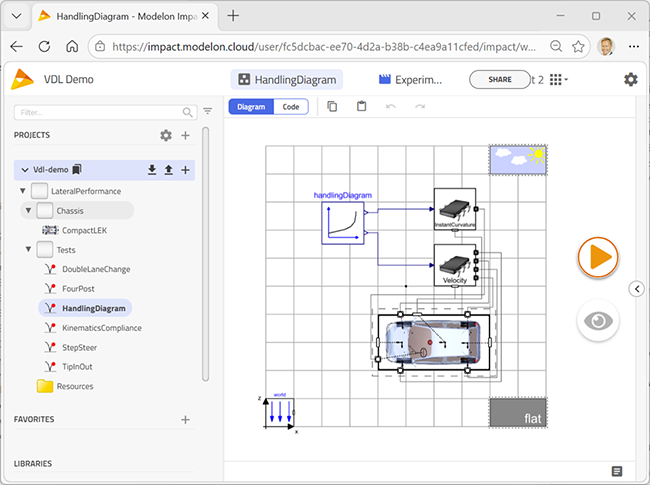
I open Modelon Impact and type:
“Improve the performance of the compact vehicle in VDL.”
The agent does not start running simulations. It proposes a way in:
“I suggest we start with a combined longitudinal and lateral steady-state analysis to establish how far the compact is from its maximum performance envelope. This gives us an objective baseline before we change anything. Shall I proceed with this approach?”
This is a good engineering instinct. You do not optimize before you understand the baseline. The agent knows this and proposes it unprompted.
I confirm the direction and narrow the scope: “Good. Let’s limit it to chassis parameters, I want to focus on the balance of the car.”
The agent proposes the parameter space: roll centers, anti-pitch and anti-dive hardpoints, mass location, inertia, springs, dampers, anti-roll bars, tires, and force distribution between traction and braking.
I adjust: “Focus on springs, dampers, anti-roll bars, and mass distribution. Leave the hardpoints and inertia for a second phase.”
The agent updates the scope and, before running anything, proposes a validation strategy: “The steady-state combined handling diagram will show us the performance envelope and where the balance breaks down. I recommend we complement it with dynamic validation: step steer for transient yaw response, tip-in and tip-out while cornering for combined load transfer, and a four-post rig to validate ride and road holding. Does this plan work for you?”
I agree. The agent executes.
Why This Way of Working is Productive
The exchange above took a few minutes. The value is not the speed, it’s the structure. Starting with a high-level question forces clarity about what I actually want, before any simulation time is spent. The agent’s proposal gives me something concrete to react to, which is almost always easier than specifying a study from scratch.
Adjustment is low cost, I redirect with a sentence rather than reconfiguring a study. Agreement creates a shared understanding of what will be done and why, so when results arrive I know what to look for.
This is not a new way of working. It is the way good engineers have always worked together, one proposing, one adjusting, both aligned before execution begins. What is new is that the execution side of that partnership has become available at a scale and speed that changes what is practical.
A study that previously required a full day of setup, execution, and interpretation can now be proposed, refined, and completed in the time it used to take just to set up. That changes what you can afford to explore.
What Makes this Possible in Modelon Impact
This workflow does not run on general-purpose AI alone. It runs on three things working together.
- Validated physics models. The Vehicle Dynamics Library in Modelon Impact contains validated, production-grade models of chassis, suspension, tires, and powertrain components. When the agent configures a combined handling diagram study or a four-post rig simulation, it is not inventing physics, it is exercising models whose behavior is already trusted. The results mean something because the models mean something. An AI agent operating on unvalidated or black-box models produces results that look plausible but cannot be acted on. Validated physics is what makes the output decision-grade.
- The ability to build exactly the right model. Modelon Impact and the Vehicle Dynamics Library give the agent the building blocks to assemble the study the problem requires, not a generic approximation. For the compact vehicle study, that means a full chassis model with the right suspension kinematics, the right tire model, and the right experiment structure for each maneuver. The agent does not adapt to what is available. It builds what is needed.
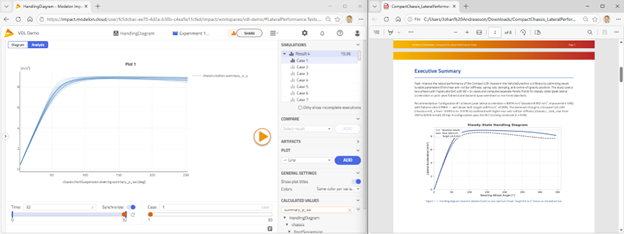
- The ability to operate the simulation environment. Modelon Impact is programmable. The agent can set up experiments, sweep parameters, run cases, collect results, extract plots, and navigate deep links within the platform, all through a structured interface that returns real data, not text descriptions of data. This is what allows autonomous execution to produce a real engineering report rather than a summary of what a report might contain. These three capabilities, validated models, composable model building, and a programmable simulation environment, are what separate a genuinely useful agentic workflow from an impressive demonstration.
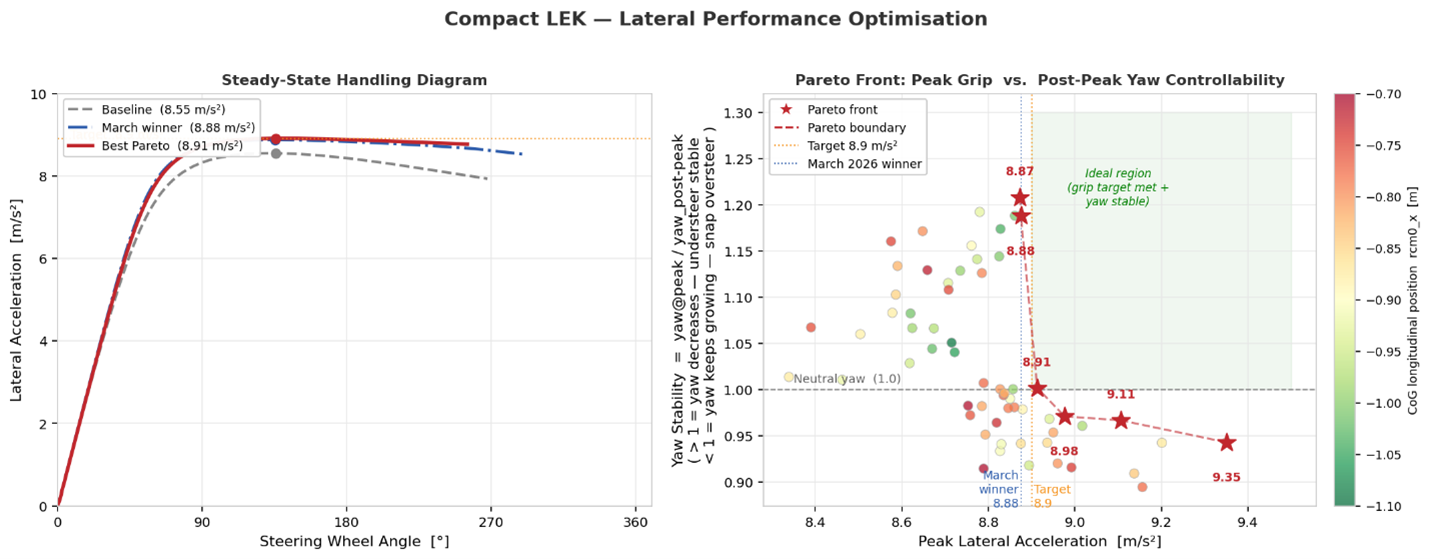
The agent then validated the shortlisted candidates dynamically. Step steer confirmed transient yaw behavior. Tip-in and tip-out while cornering stress-tested force distribution under real combined loading. The four-post simulation confirmed that the spring and damper changes that helped handling did not compromise ride quality beyond acceptable limits. The output was a structured engineering report: baseline assessment, Pareto analysis, dynamic validation results, and a specific recommendation on how to change the compact, with parameter targets, physical rationale, and expected improvement versus baseline across all validated maneuvers. It was not a summary of findings but a recommendation you can act on.
Vehicle Dynamics: A Great Showcase
I chose vehicle dynamics to illustrate this because it is an area I love, and because the Vehicle Dynamics Library in Modelon Impact is genuinely exceptional for this kind of exploration. The model fidelity is high enough that results are meaningful. The library is broad enough that the agent can always propose the right experiment, not the closest available approximation. Combined handling diagrams, step steer, four-post, NVH, durability, the full range of what matters for real vehicle development is within reach.
Your Turn…
I used vehicle dynamics. You might be working on thermal management, powertrain efficiency, HVAC, energy systems, data center cooling, or something else entirely. The physics-based foundation and the programmable environment in Modelon Impact are the enablers. The application is yours to choose. What application would you like to see agentic AI tackle in Modelon Impact? Tell me what to write about next.