From Intent to Insight: AI-Driven, Physics-Based Modeling with Modelica

Artificial intelligence is changing engineering workflows at a remarkable pace. But in the race to adopt AI, one question matters more than most:
What kinds of engineering tools are actually ready for this new era?
The answer may have less to do with flashy interfaces and more to do with something foundational: open, structured, machine-readable, physics-based modeling languages.
That is where Modelica stands out.
Why Modelica Is Built for the AI Era
There are several reasons Modelica works especially well with modern AI systems. First, Modelica is equation based. Today’s reasoning-focused language models are becoming increasingly capable at handling mathematics, symbolic structure, and constraint-based logic. A modeling language built around equations, physical relationships, and modular composition aligns naturally with how these models reason.
Second, Modelica is both human friendly and machine friendly. Engineers can read and understand physical intent directly in the code, while AI systems can parse structure, relationships, and constraints. This creates a direct bridge between domain expertise and automation.
Third, the ecosystem matters. A clear language specification, shared libraries, technical examples, open publications, and decades of adoption make Modelica unusually learnable for AI systems. This foundation allows AI to operate on Modelica models in ways that are not possible with black-box or GUI-centric tools.
It’s worth emphasizing that the strengths described above didn’t appear by accident. The Modelica community has spent decades refining a language where physical intent is expressed with clarity and transparency—and this is precisely what makes today’s AI systems able to operate on it so effectively. This foundation allows AI to generate meaningful models even from a blank slate, which we’ll explore next.
Early Signals: When AI Met Equation-Based Modeling
In 2023, before today’s reasoning models and long-context systems became widely available, we ran an experiment while preparing a pre-sales demonstration. We prompted GPT-4 to generate Modelica code for a diffusive-reactive fluid system. Within minutes, it produced syntactically correct code with coherent structure, documentation, and test examples.
The result was not perfect. One clear issue was that time derivatives were approximated using finite differences rather than the der() operator. This limitation was easy to identify and correct through a follow-up prompt.
The experience showed that equation-based modeling provides a strong substrate for AI assistance. Instead of spending time on boilerplate coding, engineers can focus on shaping questions, interpreting results, and solving the actual problem.
Fast-Forward to Today: AI Turns Engineering Intent into Models
Today’s AI systems offer longer context windows, stronger mathematical reasoning, improved code generation, and more robust debugging behavior. We explored what a general-purpose AI assistant could do in Modelica with almost no special setup.
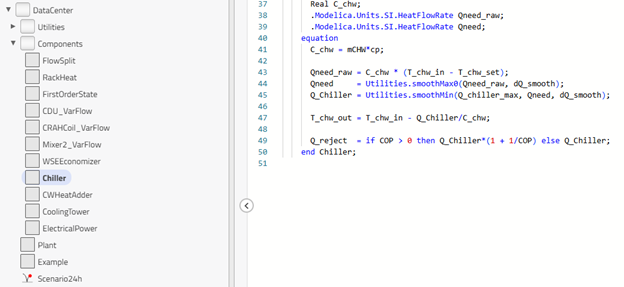
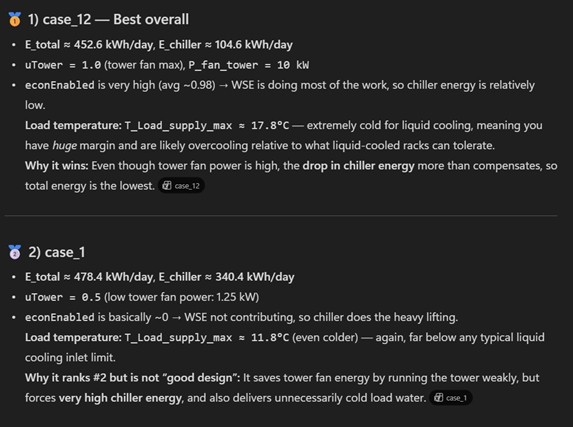
Using simple conversational prompts such as ‘define the model structure’, ‘create the components’, ‘run the simulation’, and ‘update the equations’, we guided the AI to build a small Modelica package for analyzing thermal behavior in a data-center-like system.
This workflow represents what we refer to as vibe coding in Modelica: a fast, creative way to explore model structures directly from natural language. The AI relied only on first principles and publicly available libraries.
The result was not production-grade. Important effects such as detailed hydraulics and validated component maps were missing. However, the models were physically reasonable and useful for early-stage analysis, achieved in roughly half a day starting from an empty workspace.
What Changes When Validated Libraries Are Present
Exploratory models demonstrate speed, but they also expose a boundary. Plausible is not the same as trustworthy. To understand what changes when that boundary is crossed, we ran a second experiment using validated vehicle dynamics models.
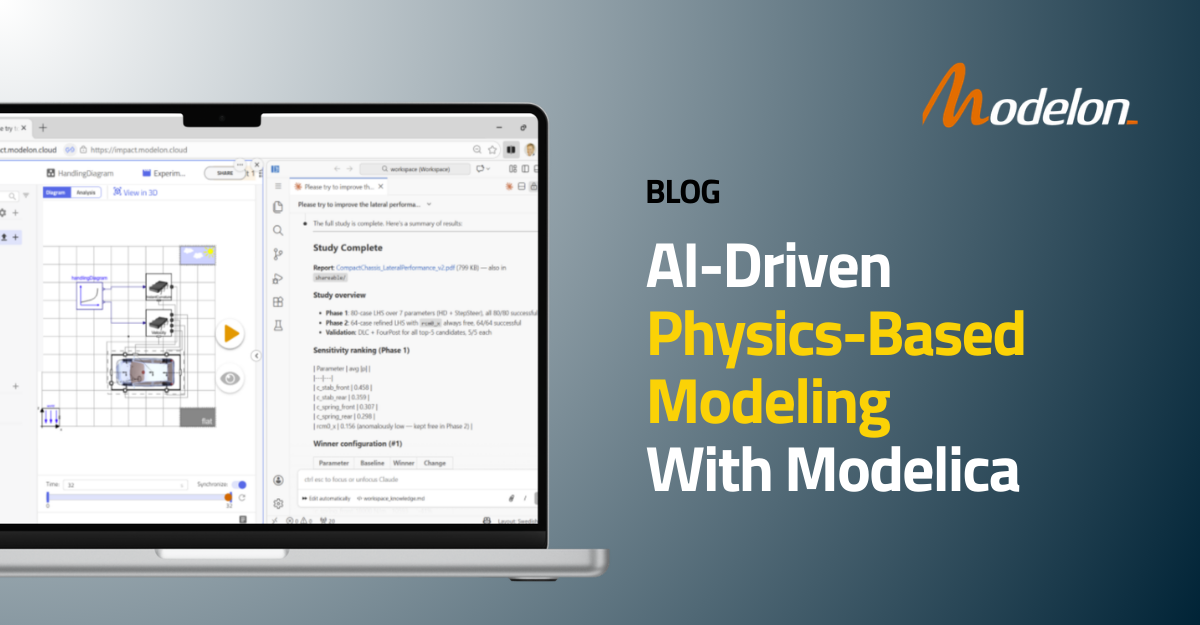
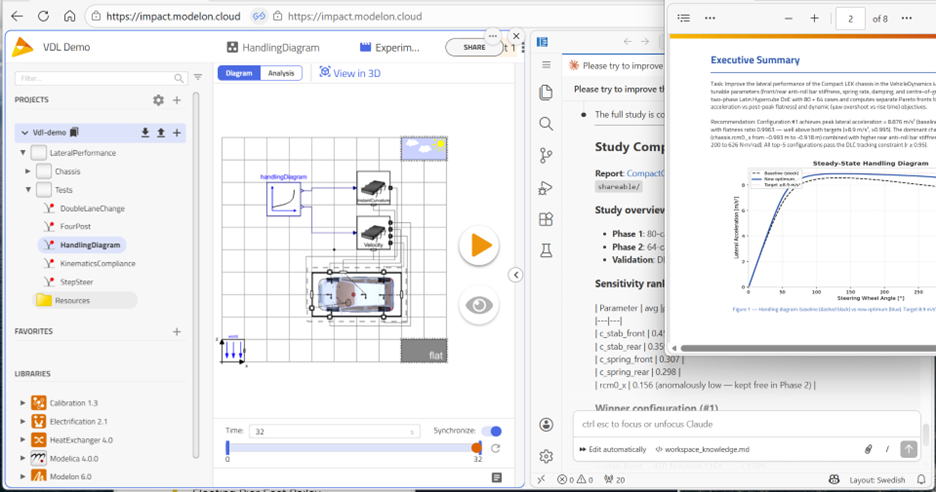
Starting from an empty workspace, we used AI assistance to set up a complete vehicle dynamics assessment based on an existing validated vehicle dynamics library. Instead of inventing components, the AI assembled and configured trusted model structures.
Within a single AI-supported session, we generated handling diagrams, transient response analyses, sensitivity studies, optimization results, and a structured engineering report summarizing the findings.
This workflow produced decision-grade results. The AI did not guess the physics. It accelerated configuration, analysis, and interpretation of models whose behavior was already trusted.
From Exploration to Engineering Acceleration
Together, these examples show the progression clearly. AI combined with Modelica enables rapid movement from intent to executable models, even when starting from nothing. Real engineering acceleration occurs when AI operates on top of validated libraries.
In practice, this requires an environment that combines equation-based modeling, programmable workflows, validated libraries, and integrated AI assistance. Product naming is intentionally kept to figures. The value lies in the physics-based modeling platform, not the language model itself.
What is your moonshot?
If AI-assisted, physics-based modeling is already possible today, the question is what problems become feasible when engineers can move from intent to insight in hours rather than weeks. Modelica did not become AI-ready by accident. It became AI-ready by design.