Digitally Engineering the Future of Data Centers
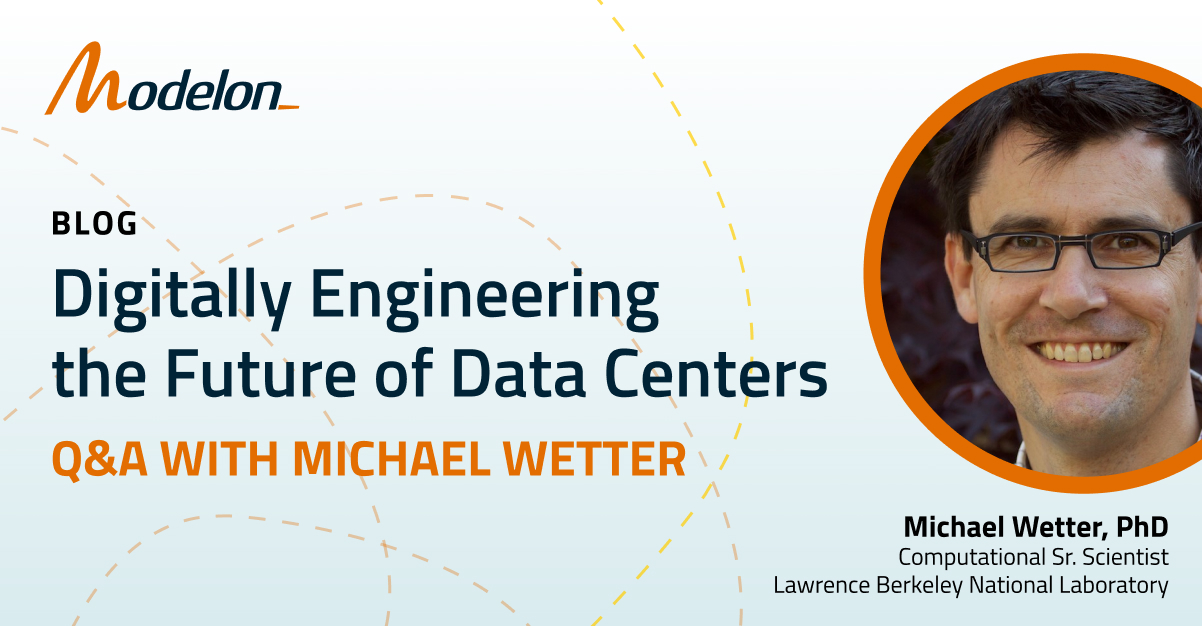
A Conversation with Simulation Pioneer Michael Wetter
As data centers scale at an unprecedented pace—driven largely by AI, cloud services, and high-density computing—the industry is confronting a new level of complexity in energy demand, cooling strategies, and the need for near-perfect uptime. Few people understand this challenge better than Dr. Michael Wetter, a leading expert in model-based systems engineering at Lawrence Berkeley National Laboratory (LBNL) and one of the primary architects behind the widely used Modelica Buildings Library whose development has been funded by the US Department of Energy, the California Energy Commission and the US Department of Defense.
Modelon sat down with Dr. Wetter to discuss how modern simulation is reshaping data center innovation, the emerging technologies creating new engineering challenges, and what the industry needs to accelerate growth.
Why Simulation Matters Now More Than Ever
According to Dr. Wetter, modeling and simulation have become indispensable tools for data center owners, designers, and operators. With soaring electricity and water consumption and increasing pressure for operational reliability, simulation offers something the physical world can’t: a safe, repeatable, environment to validate performance before systems are built or failures occur.
“Using tools like the Modelica Buildings Library, teams can model a cooling plant or energy system and de-risk design decisions before equipment is installed, and once the system is operational, they can use the model as a digital twin to make adjustments to optimize operations and adapt proactively to extreme events,” explains Wetter.
Heat waves, for example, sharply increase cooling power requirements. With simulation, operators can forecast the impact on electricity usage or water consumption and adjust their operating strategy before the event occurs improving reliability and reducing unnecessary cost or risk.
De-Risking Design and Improving Reliability
Uptime is the defining KPI for any data center. Even a brief cooling failure can force operators to throttle or shut down IT equipment which is an extremely expensive and reputation-damaging outcome.
Dr. Wetter notes that simulation helps avoid these outcomes by making it possible to test control sequences, emergency responses, and new operating strategies offline. “You cannot test failure modes or extreme conditions on a live data center. The cost is too high. But you can test them in simulation,” Wetter explains.
By modeling the mechanical systems and the control logic together, teams can evaluate:
- Responses to power loss or grid curtailment
- The effect of IT load spikes on the energy system
- Extreme weather events
- Equipment staging and sequencing
- Grid-interaction strategies such as demand flexibility
The Modelica Buildings Library, which LBNL maintains and Modelon contributes to and supports, provides the physics-based models that underpin these analyses.
Victor Braciszewski
Sr. Mechanical Engineer, SmithGroupEmerging Data Center Technologies Bring New Modeling Challenges
The industry consensus is clear: the next decade of data center development will be defined by the transition to liquid cooling and energy system integration.
“Liquid cooling is relatively new and comes in many forms: cold plates, immersion cooling, hybrid systems. Their dynamic behavior and integration with the mechanical plant are not yet well understood and offer new opportunities for efficient provision of cooling. This is where modeling can significantly reduce cost and improve reliability,” says Wetter.
Simulation enables faster adoption of these advanced cooling solutions without over-engineering or sacrificing uptime. The Buildings Library provides a robust foundation for representing component physics, with the flexibility to tailor and extend models for specific cooling technologies. For advanced chip-level heat transfer, Modelica can even be co-simulated with finite-element tools using FMI, giving engineers a truly multi-scale view.
A Shift Toward Holistic, Integrated System Design
One of the biggest challenges Dr. Wetter sees is cultural, not technical: data centers are still designed largely through siloed engineering workflows. Mechanical engineers, electrical engineers, controls teams, and IT system designers often optimize their subsystems independently, leaving opportunities for improved integration unexplored.
He argues that the answer lies in adopting methodologies already proven in automotive and semiconductor industries. “Platform-based design and model-based systems engineering allow teams to integrate verticals—from chip cooling to central plant design—into a single performance-driven workflow.”
This shift would enable:
- Earlier and more informed design decisions
- Rapid iteration using virtual prototypes
- Clear specification of component requirements
- Continuous verification from design to deployment
- More cost-effective, scalable energy systems
Modelon supports this transformation with expert engineering guidance, specialized software for energy and thermal systems, proven libraries developed with partners, and cloud-based collaboration and workflows.
Lowering Barriers to the Adoption of Simulation
During the conversation, Dr. Wetter identified two major hurdles preventing broader industry uptake of simulation:
- A shortage of trained modeling professionals
- Limited access to scalable workflows and domain support
He sees a major opportunity for companies like Modelon to support capability-building in the market. “Modelon has an important role to play in training the industry and helping companies get up to speed. That’s essential for scaling the use of these technologies.”
As the market accelerates and data centers become increasingly mission-critical infrastructure, the need for trained modelers and accessible modeling workflows will grow rapidly.
Looking Ahead: Data Centers as Model-Driven Systems
When asked what excites him most about the next 5–10 years, Dr. Wetter envisions a future where models become central to how data centers are designed, built, and operated. “We hope to see models become formal specifications of the system and used from concept design through deployment and continuously updated during operation. This would transform reliability, scalability, and cost.”
That vision aligns directly with Modelon’s commitment to open standards like Modelica and FMI, and to enabling simulation-driven engineering practices across the data center ecosystem.
Creating Awareness in an Industry Ready for Change
Perhaps the most striking point in the conversation was this: despite the enormous value simulation can deliver, awareness in the data center industry remains low.
At major data center events, Wetter has found that very few professionals are aware of the power and availability of advanced simulation. “There is a huge opportunity to bring these tools to the forefront. The industry needs them, it just doesn’t know it yet.”
Through collaboration with researchers like LBNL and support from industry partners, awareness and accessibility are rapidly growing and Modelon is leading that charge.
Partnering to Engineer What’s Next
Data centers power the digital world. Ensuring their performance and reliability in an era of rapid growth requires a new level of engineering sophistication that physics-based simulation and open-standard modeling are uniquely positioned to deliver. They offer
- Faster and more confident design decisions
- Better energy and cost performance
- Safer adoption of modern cooling technologies
- Higher uptime and reliability under stress
Through leaders like Dr. Michael Wetter and technologies like The Buildings Library in Modelon Impact, the path toward more efficient, and intelligent data center design is becoming clearer.
How Modelon Helps with Data Center Design and Optimization
Modelon is here to help you advance confidently. Whether you’re exploring system simulation for the first time or scaling across global design programs, Modelon and it’s system-level software platform, Modelon Impact, provide:
🔹 Data center domain expertise
🔹 Purpose-built simulation tools
🔹 Hands-on training and onboarding
🔹 Quality assurance and long-term support
Connect with Modelon experts to build data centers engineered for the future with certainty, speed, and sustainability.